
Restaurant Flatware Buying Guide: Weight, Finish, Reorders
Why 'heavy' is not a weight: per-piece gram figures from our drawings, pattern continuity and what a test report covers when you buy restaurant flatware.
Restaurant flatware is bought twice: once on the quote, and then again every month after that, piece by piece, out of whatever budget covers breakage and loss. The first purchase is the one buyers plan for. The second is the one that decides what the programme costs, and it is set by four things you can write down before you ask for a price: how much each piece weighs in grams, which pieces your menu actually uses, whether the pattern will still exist in three years, and what the test report in front of you covers.
This restaurant flatware buying guide works through those four in the order they arrive. Every weight and length below is printed on one of our own product drawings rather than borrowed from a weight band, because the bands are where most specifications go wrong.
Table of Contents
Start With the Service, Not the Pattern
Write down what your operation does to flatware before you open a catalogue. These six answers set weight, finish, piece count and supplier fit more firmly than any preference about how a handle looks.
- Covers and peak turns. A 60-seat room turning three times at dinner carries a different inventory from a 200-seat banquet hall that fills twice a week.
- Wash method and cycle volume. Rack-and-conveyor machines, flight machines and three-compartment sinks handle pieces differently, and a busy dish pit cycles the same fork many times a day.
- Loss, counted rather than assumed. This is the line most operators leave blank, and it is the one that pays for the order.
- Storage. Deep drawers and cylinder racks hold a finite number of pieces; specialty items you use twice a month take space from the ones you use every service.
- What the menu asks for. Steak knives, oyster forks, bouillon spoons and demitasse spoons earn a place only if the menu calls for them.
- Whether flatware is part of the brand. A mark on the handle and a distinctive finish is one brief; the lowest cost per cover is another, and they lead to different suppliers.
On loss, measure instead of adopting a number. Count each piece type at the start of a period, add what you bought, subtract the closing count, and divide by the opening count. The figure that comes out is yours and nobody else's. Check which piece types account for most of it, because the buffer belongs where the loss is rather than spread evenly across the set. Ranges quoted in guides are starting assumptions for a first year, not a measurement of your room.
What Does "Heavy" Weigh in Grams?
It weighs anything from 22 to 139 grams in our own ranges, and that spread sits inside patterns sold to the same buyer. Weight is not a category you can name; it is a number you have to ask for.
Weight comes from the thickness of the metal and the way the piece is formed, not from the steel grade. Grade and weight are two separate decisions, and buyers routinely merge them. The table below is drawn from four of our patterns, each with per-piece values printed on its own drawing.
| Piece | Classic smooth handle | Baroque pattern | Fluted handle | Narrow hammered |
|---|---|---|---|---|
| Main-course fork | 39 g / 20.7 cm | 62.1 g / 20.2 cm | 76 g / 20.7 cm | 101 g / 20.3 cm |
| Knife | 70 g / 22.8 cm | 90 g / 23.4 cm | 139 g / 24.2 cm | 121 g / 24.5 cm |
| Large spoon | 45 g / 20.5 cm | 72.6 g / 20.2 cm | 93 g / 20.5 cm | 115 g / 20.3 cm |
| Small spoon | 22 g / 14 cm | 48.6 g / 17.3 cm | 36 g / 13.2 cm | 58 g / 16.3 cm |
The classic range's drawing labels its main-course fork simply "fork"; the other three label the same piece "large fork". The values are the ones printed on those drawings, not production tolerances — a sample is what confirms what a factory will actually ship.
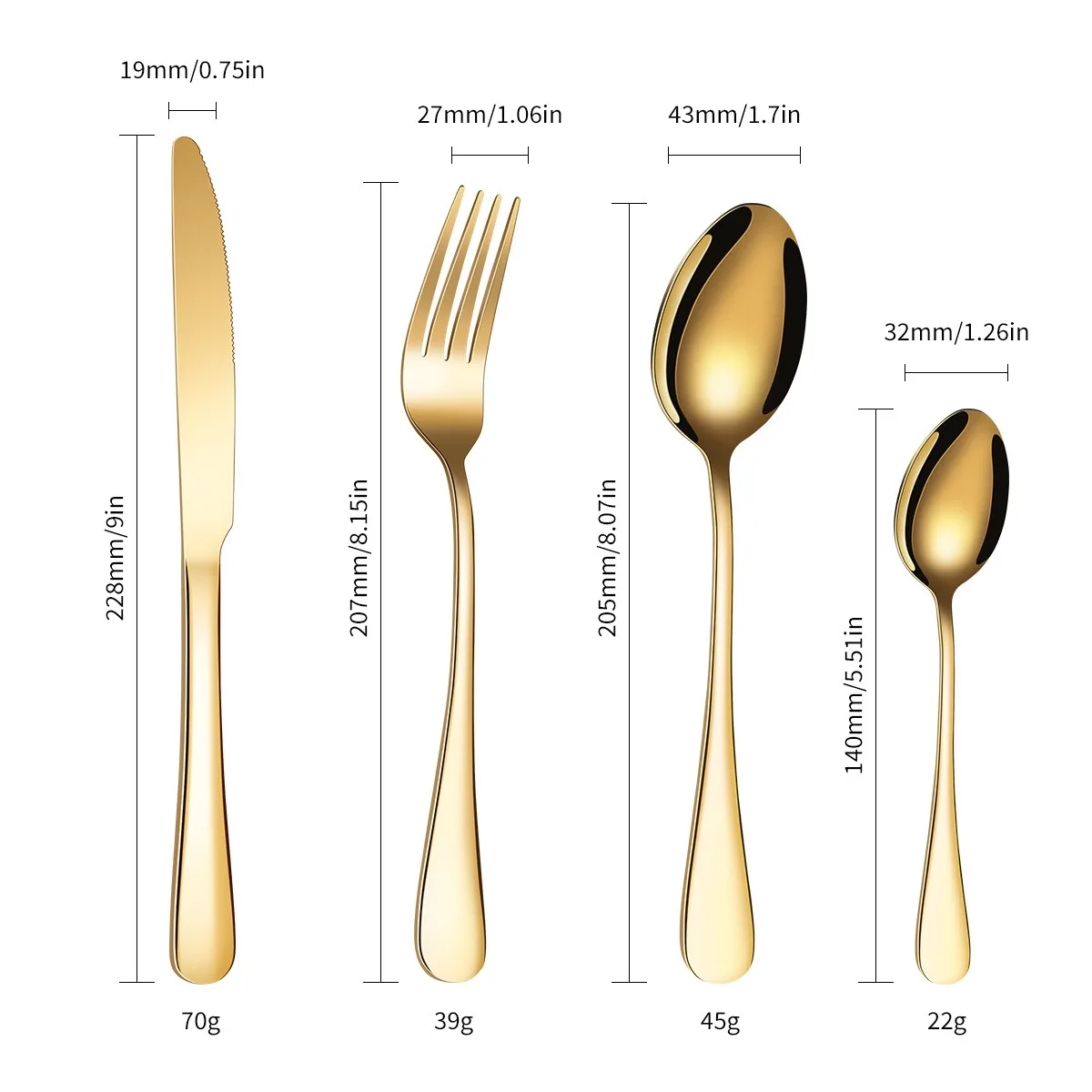
Read the fork line twice. The four main-course forks sit within five millimetres of each other — 20.2 to 20.7 cm — and weigh 39, 62.1, 76 and 101 grams. All four are stainless steel flatware from one catalogue. Length told you almost nothing; thickness and construction told you everything. A buyer who specifies "heavy, 20 cm dinner fork" has fixed the length and left the one variable the guest feels, and the one that resists bending, to whoever picks the steel that week.
The second reading is inside a single pattern. In the fluted handle set the small fork is 32 g and the knife is 139 g, a spread of more than four times. A set is not one weight; it is five or six of them, and the piece you should handle before committing is the one your guests use most. On a dinner menu that is usually the fork; in a café it is the teaspoon.
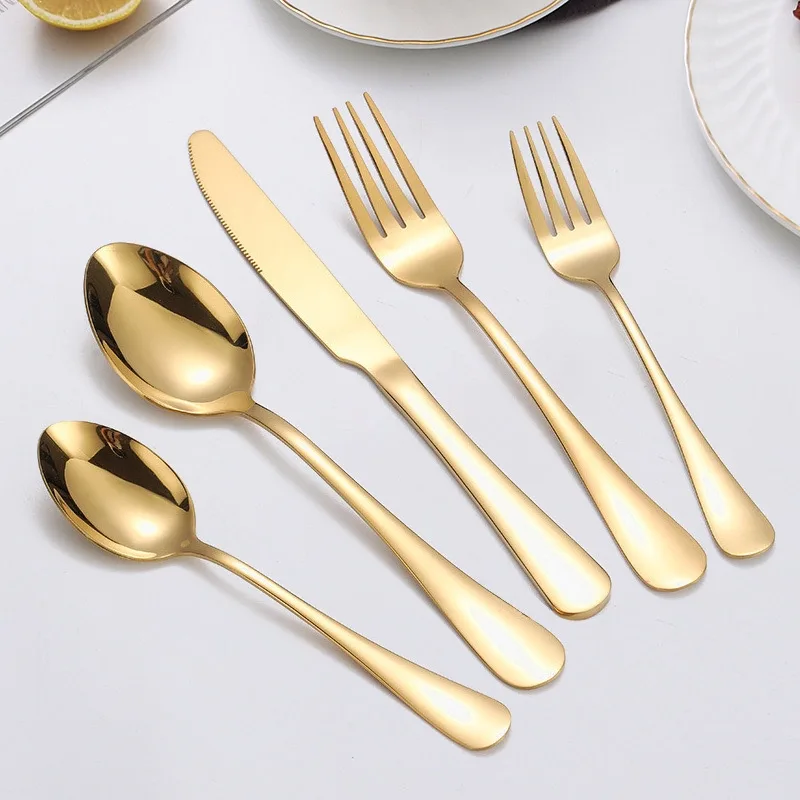
What this means for the order is simple. Ask for the weight of every piece in grams, not a weight class, and compare candidates line by line rather than photograph by photograph. If the answer to "how heavy is the fork" is "heavy", the specification is still blank.
Which Pieces Does Your Menu Actually Use?
Start from a five-piece setting — knife, fork, salad fork, large spoon and teaspoon — and add only what the menu justifies. The naming problem behind that list has a guide of its own: how table knives, forks and spoons are named and sized so that the twenty-centimetre piece on the quote is the one you meant.
The pieces worth debating, and the reason to add or skip each:
- Teaspoon. Usually the highest-count piece you will order, because it serves drinks as well as dessert. Order it by the tray, not by the dozen.
- Demitasse spoon. Essential if you run espresso service, dead weight if you do not.
- Bouillon spoon. A smaller round bowl for broth served in cups.
- Iced tea spoon. A long handle for tall glasses and stirred drinks.
- Cocktail or oyster fork. Appetizers, shellfish, olives and cheese.
- Butter knife and serving pieces. Front of house rather than place setting; our serving utensils range covers the group.
For quantity, the flatware buying guide published by KATOM suggests four pieces per seat of each type you set in a casual dining room, adjusted for turn rate and menu. Treat it as a starting assumption and replace it with your own count: multiply seats by the pieces per seat you have decided on, then add the measured buffer from the loss count above across the two or three pieces that disappear fastest.
How Does the Room Change the Choice?
Each concept trades weight, finish durability, piece variety and brand expression differently, so the same set does not serve all five.
Fine dining. The weight goes up and the specialty set widens: a main-course fork near 100 g, a knife over 120 g, mirror polish, and the full spread of fish, dessert and demitasse pieces. The narrow hammered pattern carries the heaviest fork of the four in the table above.
Hotels. One pattern family across restaurants, bar, banquet and in-room dining simplifies stock and keeps the table looking the same on every shift. Treat in-room dining as the harshest test in the building — pieces leave the property on trays and come back hours later — and set its buffer higher than the dining room's.
Casual dining. Medium to heavy, simple shapes, fewer specialty pieces, a finish that hides handling marks. This is where the arithmetic matters most: multiply the loss rate you measured by the unit price and compare candidates on annual replacement cost rather than on the opening price. The classic smooth-handle range, with its 70 g knife, sits at the lighter end; the fluted handle set, with a 139 g knife, sits at the heavy end.
Cafés and bistros. Lighter pieces, teaspoons and demitasse spoons in proportion to drink service, and short frequent wash cycles that test coloured handles before anything else. Handle colour and texture do useful brand work in a small room.
Chains. Treat flatware as a controlled SKU with a written spec sheet — pattern reference, grams per piece, finish, piece list, packaging, documentation — rather than as a purchase each site makes for itself. That is what keeps the fork in location twelve identical to the fork in location one.
Finish belongs in the same conversation, because it decides how the set looks after a year of washing rather than on the day it arrives. We compare mirror, brushed, sandblasted and colour-coated surfaces piece by piece in our guide to flatware surface treatment; the short version is that the finish you cannot re-match later is the one that turns a lost fork into a re-set table.
What Should a Restaurant Flatware Specification Fix?
A specification is what survives a change of factory, a new purchasing manager and a repeat order three years later. Put these on one page and send it with the enquiry:
- Pattern reference and piece list, in the names your supplier uses, with the count of each piece.
- Grams per piece, measured on an approved sample as well as quoted.
- Length per piece, in millimetres.
- Steel and construction, as the supplier will certify it, not as a marketing label.
- Finish, named by process and by appearance, with the approved sample kept.
- Packaging, down to pieces per set and sets per carton.
- Documentation, naming the product, grade and finish you are buying.
- Repeat-order terms, in writing.
A quote answers the specification it receives. Send a pattern name and it will answer with a pattern name, at whatever weight the factory considers standard for it.
Will You Be Able to Re-Order the Same Pattern?
Ask before the first order, because the answer decides what a broken fork costs. If a pattern stays in production, a lost piece is a re-order. If it does not, or if a coloured finish cannot be matched batch to batch, the same loss becomes a re-set: every piece on the table has to be replaced to keep it uniform.
Three questions belong in the original email. Is this pattern open stock, kept in continuous production so single pieces can be ordered years later? How are repeat orders for it handled two or three years out? Can spares ship inside the first production run, where they match by definition? A supplier who cannot describe the process is telling you something, and it is cheaper to hear it now than after the first breakage.
What Does the Paperwork Actually Cover?
A test report covers the sample and the methods submitted to the laboratory. It is not a company certification, and it is not evidence that every piece in the range has been tested. We publish the cover pages of three SGS test reports on our manufacturing and testing page, and they are a useful worked example of how far such a document reaches:
| Report number | Scope as printed on the cover page | Date | Result |
|---|---|---|---|
| GZHL2406026935CW | Cadmium and cadmium compounds in stainless flatware, REACH Annex XVII entry 23 | 2 July 2024 | Pass |
| CANHL24013953701 | Total chromium content, US FDA GRAS specification | 4 July 2024 | Pass |
| CANHL24013953501 | Sensory test and extractable heavy metals, LFGB sections 30–31 and EC 1935/2004 | 4 July 2024 | Pass |
Three things follow from that table. The first is that a cover page is a summary: the sample identification, the methods and the pages behind it are what a buyer needs, and a report number on a website is a starting point for a request rather than proof. The second is that none of the three names a coating, so a coloured or coated piece needs documentation of its own. The third is that the scope is specific in both directions — it says what was tested and it says what was not.
So before a container ships, ask for the full report that names the product, the grade and the finish you are buying; ask which parts of the set it covers; ask the laboratory on the report whether it issued that document; and check that the entity and the production site on it are the ones in your contract rather than a parent company or a trading office. A supplier who can walk through all four is telling you how the next order will be run.
Keep the approved sample, the specification sheet and the report together, numbered to the same order.
What to Send With the Sample Request
Send the specification page, the quantities, the destination market and the packaging you need in one message, and ask for the sample, the per-piece weights and the matching test documentation in the same reply. That single request tells you most of what a factory visit would.
Our ranges are listed on the wholesale flatware page, and the fluted set used above is documented on its own page — the five-piece flatware set with fluted handles — alongside the baroque-pattern set, the narrow hammered set in gold or silver and the classic smooth-handle range. Custom shape, handle material, marking, colour and packaging are discussed per project on our custom cutlery page; the minimum order is set per style and quoted with your specification. Send it through our contact page.
Frequently Asked Questions
Is a heavier piece always the better buy? Not automatically. Heavier stock resists bending better, but the cost of the programme is weight multiplied by loss, and a heavy piece lost at the same rate costs more to replace. Weigh the candidates, measure your loss, and compare annual replacement cost rather than the opening price.
Does the steel grade tell me how heavy the flatware is? No. The grade describes the alloy; thickness and construction decide the weight. Inside one of our patterns a knife and a small fork differ by more than a hundred grams.
What is the difference between a dinner fork and a salad fork on a quote? Names are conventions, not measurements, so the reliable difference is length and weight on the drawing. The guide to flatware names and sizes sets out the families and how to read them.
What is your minimum order? It is set per style, because the pattern, the finish, the packaging and the quantity you take all move it, and it is quoted with the specification you send.
Which piece should I handle before placing a restaurant order? The one your service uses most: the main-course fork on a dinner menu, the teaspoon in a café. Order a small quantity and use it in service for a week before committing to a programme.
If you have a quote in front of you, take the specification list above and work down it line by line. Whatever you cannot answer from the supplier's own documents is what to ask before the sample ships — and the answer you cannot get is the part of the order you have not specified yet.