
Stainless Steel Flatware Surface Treatment: Mirror, Brushed, Sandblasted and PVD Compared
Compare mirror, brushed, sandblasted and PVD finishes for stainless steel flatware: how each surface treatment is produced, how it wears, cleans and photographs, and how to specify a finish that stays consistent across repeat orders.
Surface treatment is one of the first things a diner notices and one of the last things a procurement team thinks to specify. Two spoons can share the same 18/10 stainless steel body and still behave very differently on a table: one shows every fingerprint, another hides scratches for years, a third carries a color that defines the brand. For wholesalers, hotel groups and e-commerce sellers, the finish is a product decision with cost, maintenance and consistency consequences.
This guide covers the four finishes most often requested in stainless steel flatware — mirror, brushed, sandblasted and PVD coating — explains what each process actually does to the surface, compares them side by side, and sets out how to choose and specify a finish that holds up across repeat orders.
Table of Contents
What Surface Treatment Does to Stainless Steel Flatware
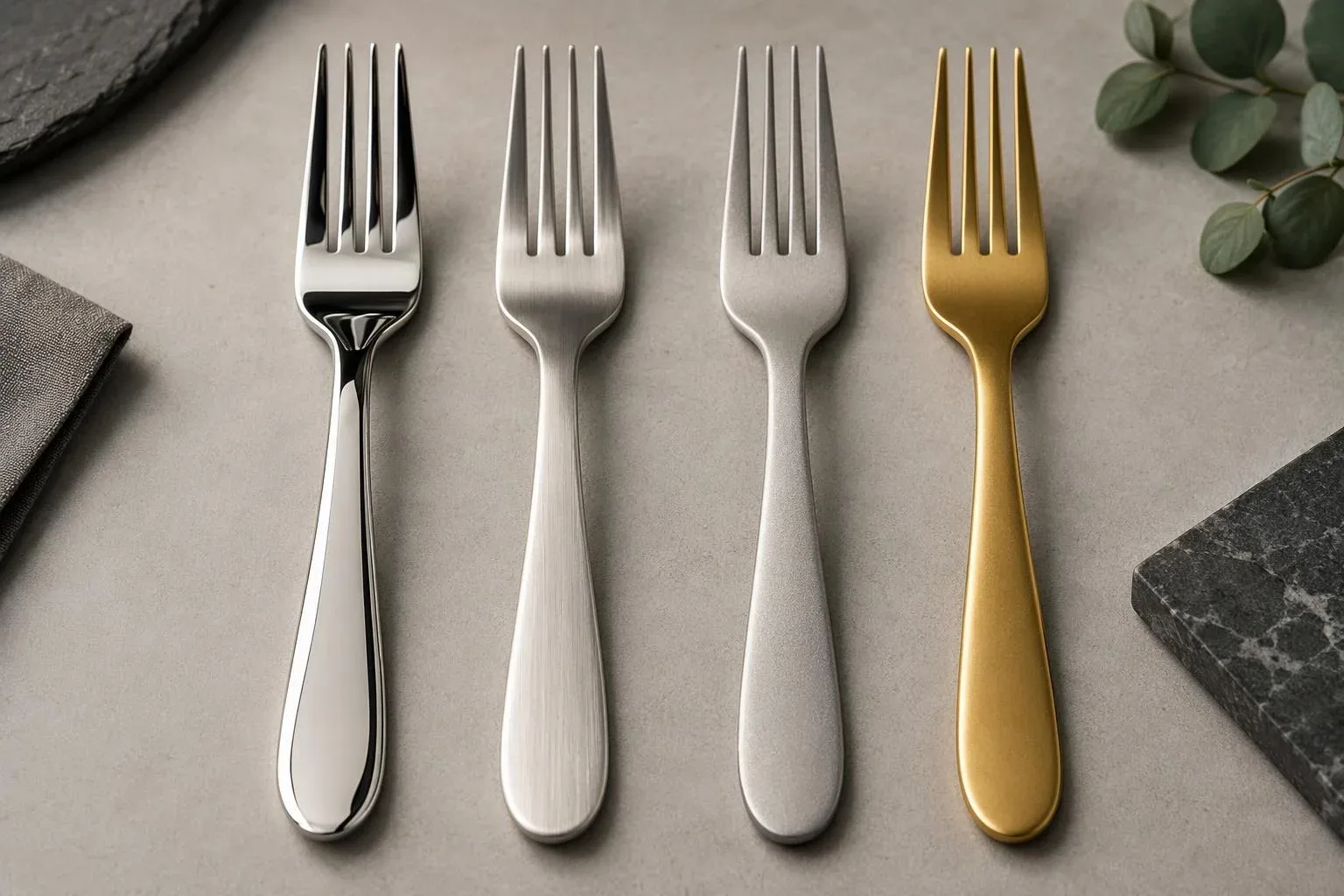
Every finish starts with the same raw material. The stainless steel grade — 18/10 (304), 18/8 (304), 18/0 (430) or 13/0 (410) — determines the corrosion resistance of the piece. The finish determines how that surface looks, how it wears and how much effort it takes to keep clean.
Mechanical finishes such as mirror polishing, brushing and sandblasting reshape the steel surface itself. PVD coating is different: it deposits a very thin ceramic film, typically well under a few microns thick, onto a prepared stainless surface in a vacuum chamber. The film is hard and bonds strongly to clean steel, but it sits on top of the base metal rather than replacing it.
That distinction matters for buyers. A mirror polish makes a surface more reflective but does not make the underlying alloy more corrosion-resistant. A PVD coating can add wear resistance and color, but industry guidance on special stainless finishes is explicit that such coatings should not be considered a substitute for using an appropriate stainless steel grade in aggressive environments. If a product line will face heavy dishwasher cycles, acidic foods or humid storage, the grade decision comes first and the finish decision second.
Mirror Finish: High Gloss and High Maintenance
Mirror finish is produced by polishing with successively finer abrasives and then buffing to a high-luster surface. In stainless steel standards, this corresponds broadly to the No. 8 finish, described in ASTM A480/A480M as a highly reflective, smooth finish typically produced by polishing with successively finer grit abrasives, then buffing. Very faint polish lines may still be visible on the final product.
The result is the classic bright, reflective flatware most diners associate with formal dining. It photographs well, reads as premium on a retail shelf and suits banquet halls, fine-dining rooms and gift sets.
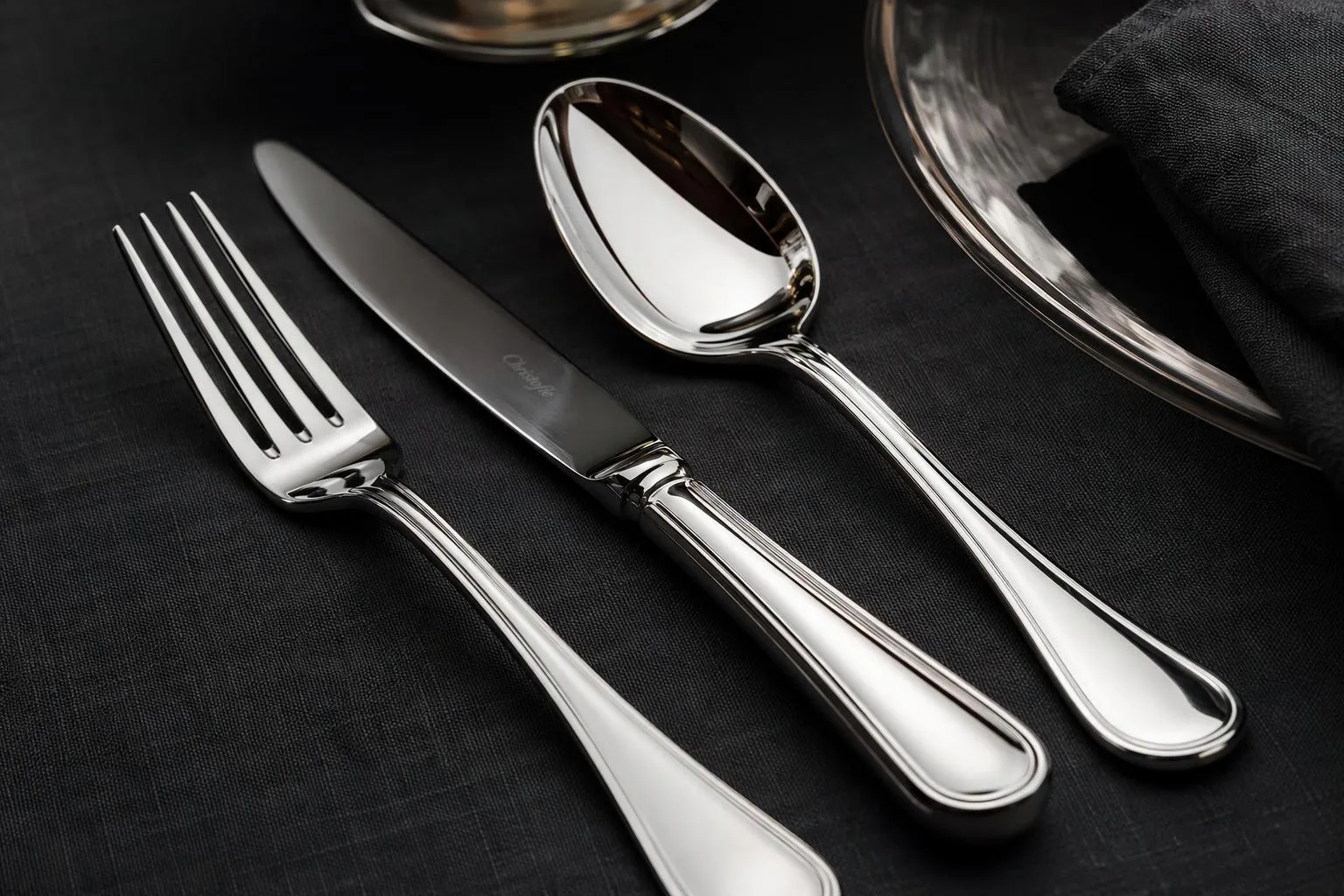
The trade-offs are equally clear:
- Scratch visibility. Fine scratches and abrasion marks stand out against a mirror surface far more than against a textured one.
- Fingerprint visibility. Handling marks show readily, especially under direct light.
- Cleaning attention. Water spots and smudges need prompt wiping to keep the surface looking right.
Mirror finish rewards careful handling. In high-volume commercial operations, that means accepting a shorter cosmetic lifespan or budgeting for more frequent replacement of front-of-house pieces.
For buyers building a formal range, our wholesale flatware collection and custom cutlery gift sets are both available in mirror finish.
Brushed Finish: The Workhorse for Daily Service
Brushed finish — also called satin — is created by running the surface against abrasive belts or brushes to produce fine, directional grain lines. It is the finish most commercial kitchens and modern restaurants settle on, and for good reason.
The linear texture scatters light instead of reflecting it, so the surface reads as soft and matte rather than glossy. More importantly, the grain disguises the small scratches and scuffs that accumulate through washing, stacking and service handling. Maintenance is straightforward: a soft cloth, mild detergent and drying along the grain direction keep the surface consistent.
Two practical points for buyers:
- Grain direction matters. Brushed surfaces are directional. On flatware this is less visible than on large architectural panels, but consistency of grain across a set still affects how uniform the collection looks.
- Cleaning along the grain. Wiping across the grain can leave visible marks; staff should be trained to follow the line of the texture.
Brushed finish suits daily-use restaurant flatware, modern and industrial-style table settings, and hotel banqueting where pieces see constant handling. It is also a common base for PVD coating, which we will return to below. Typical applications include bulk flatware programs, stainless steel spoons and serving utensils.
Sandblasted Finish: Texture, Touch and Design Character
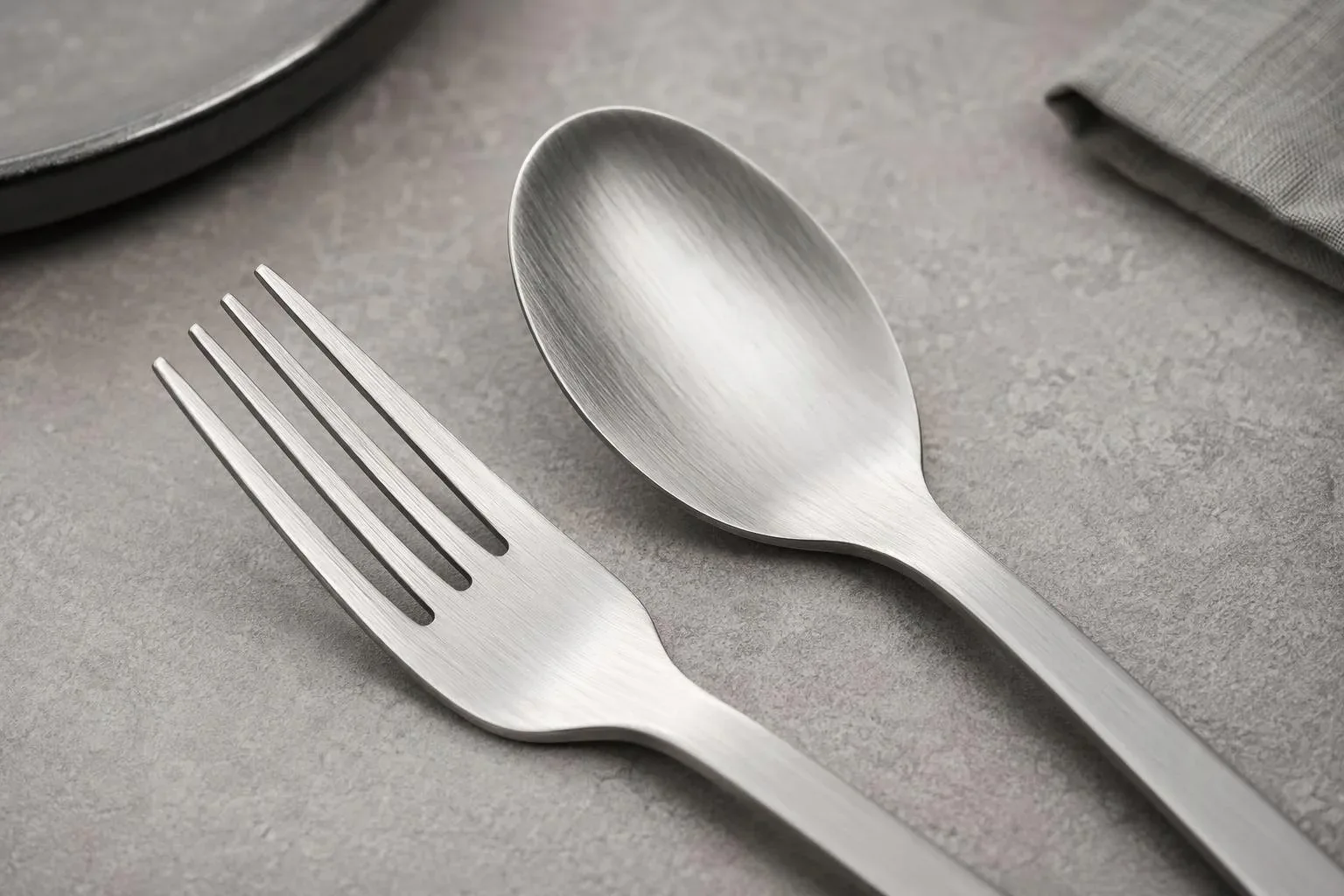
Sandblasting — more generally, abrasive blasting — propels fine media at the steel surface to create a uniform, non-directional matte texture. Unlike brushed finish, there is no grain line; the surface is evenly frosted across the whole piece.
That non-directional texture gives sandblasted flatware a distinctive soft-touch feel and a contemporary, design-forward look. It suits brands building a signature aesthetic, gift and hospitality ranges, and settings where the tactile experience is part of the presentation.
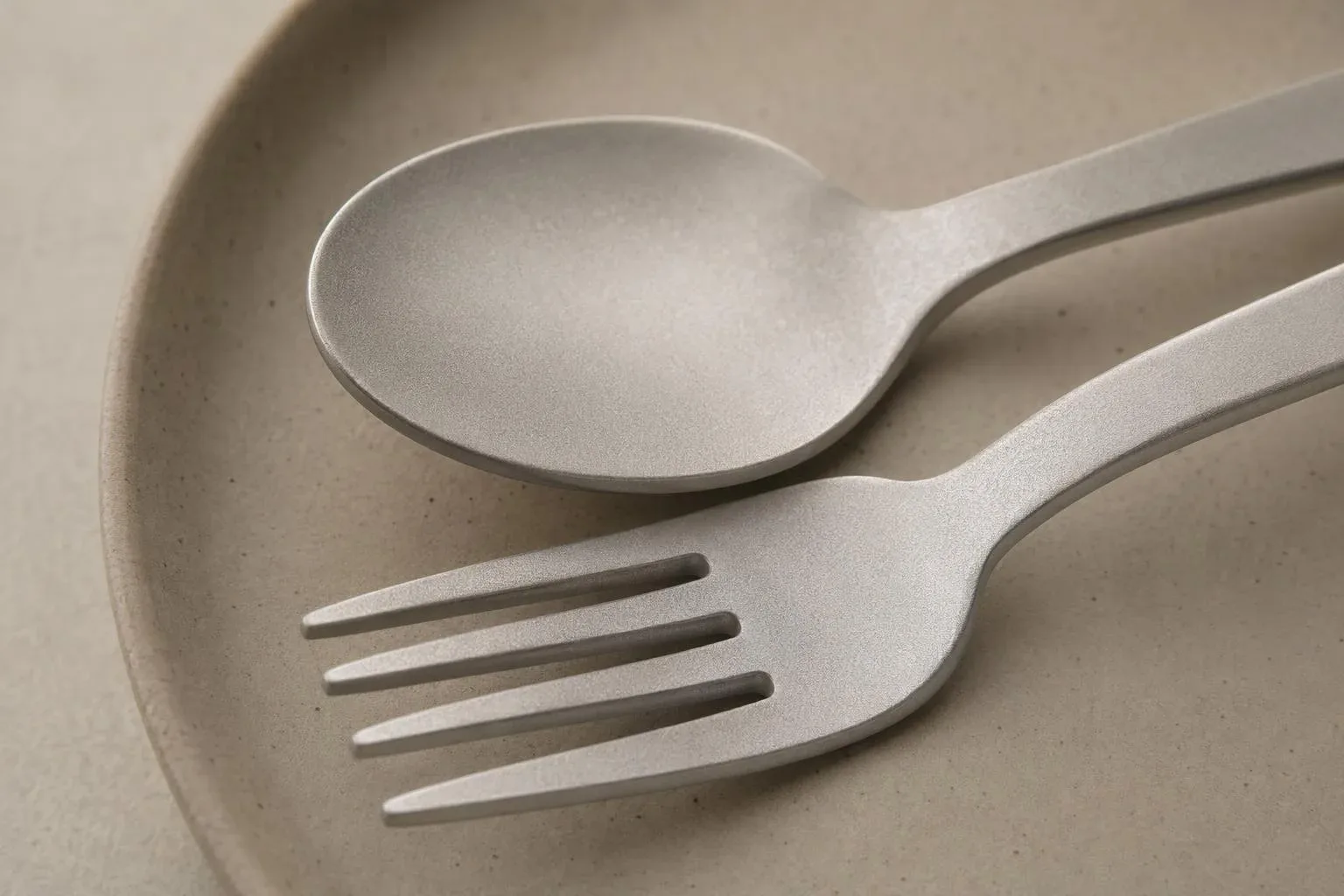
The practical considerations:
- Fingerprint behavior. Matte textures generally show fingerprints less starkly than mirror, but rougher blasted surfaces can trap marks. Worldstainless guidance notes that fingerprinting can be a problem particularly on rougher finishes, where marks may become permanent if not removed promptly.
- Cleaning method. A soft brush or cloth is preferable to abrasive scrubbers, which can flatten the texture unevenly.
- Consistency. Because the texture is created by media blasting, uniformity depends on controlled process parameters — a point worth confirming with the supplier at sample stage.
Sandblasted flatware is less common than mirror or brushed in high-volume food service, but it is a strong differentiator for brands that want a recognizable surface identity — for example in custom portable cutlery sets or children's cutlery sets.
PVD Coating: Color, Wear Resistance and the Base-Surface Effect
PVD — physical vapor deposition — deposits a thin ceramic film onto prepared stainless steel in a vacuum chamber. A source material such as titanium or zirconium is vaporized and reacts with gases in the chamber; the resulting compound condenses on the parts. Titanium nitride produces a gold color, and other compounds and process recipes yield rose gold, champagne, bronze, copper, gunmetal and black.
Three characteristics matter most for flatware buyers:
The film is thin and follows the surface. Because the coating is typically well under a few microns thick, it takes on the texture of the surface beneath it. PVD over a mirror finish gives mirror gold; PVD over a brushed finish gives brushed gold or champagne; PVD over a sandblasted finish gives a soft satin metallic. This is why the same color specification can look noticeably different depending on the base finish — the color is the film, but the character is the substrate. Industry guidance on PVD for stainless makes the same point: PVD normally retains the underlying topography and should not be expected to level brushing, grinding marks or surface irregularities.
It adds hardness and color stability. Applied properly, PVD is colorfast, resists humidity and most household chemicals, and is hard enough to resist ordinary wiping and light contact. That makes it the finish of choice for colored brand lines, gift-market ranges and premium customization.
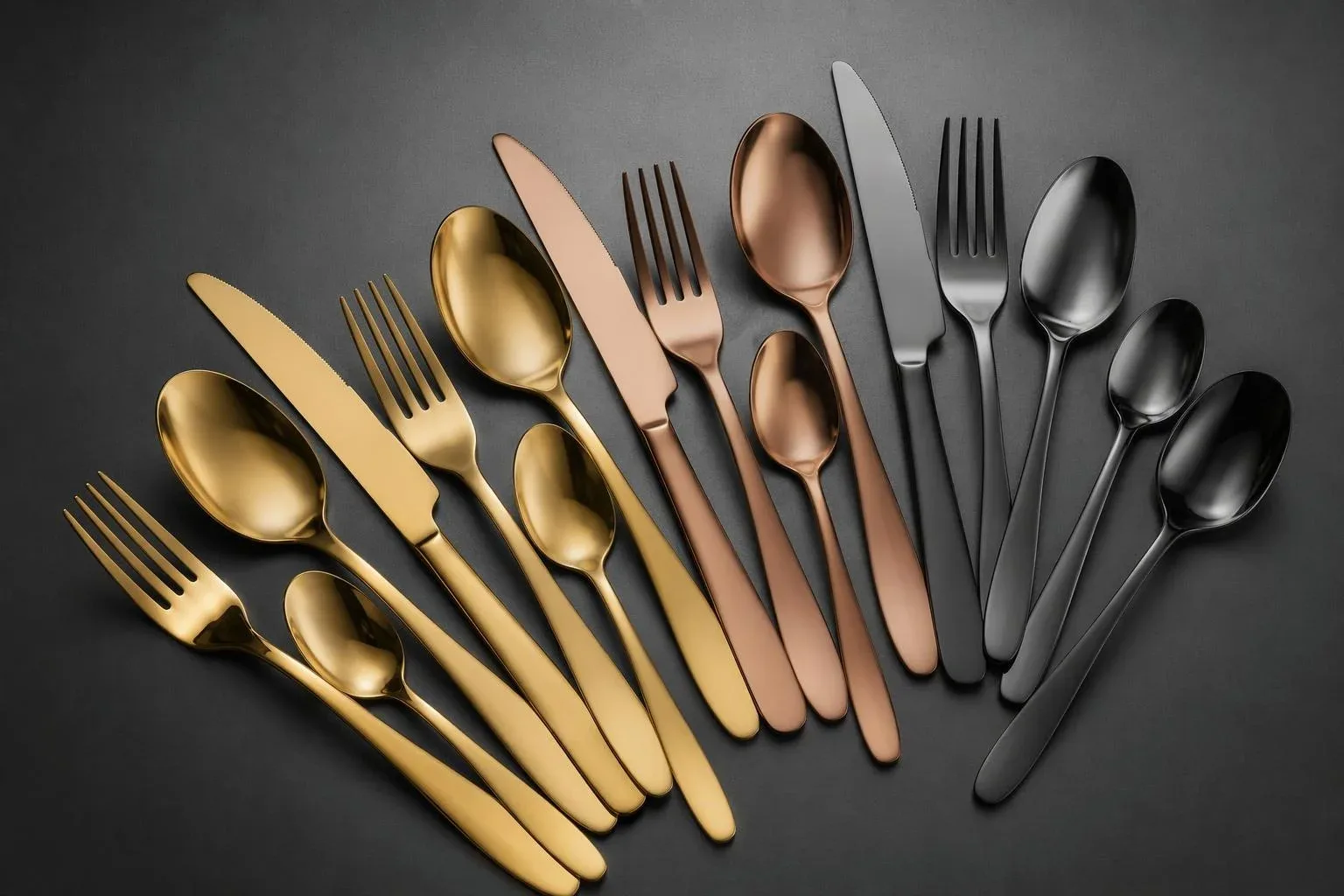
It has clear limits. The film is thin, so a deep scratch can reach the steel below and show as a silver line; it cannot be polished out or touched up locally. Colors can vary slightly between batches and suppliers, so pieces for one program should come from the same batch where possible. And PVD on a poor base — a lower-grade stainless that corrodes beneath the film — can fail at the base rather than the coating.
Comparing the Four Finishes Side by Side
The table below summarizes the qualitative differences. Cost tiers are relative and indicative only; actual pricing depends on grade, volume, design complexity and order terms.
| Criterion | Mirror | Brushed | Sandblasted | PVD Coating |
|---|---|---|---|---|
| Appearance | High gloss, strong reflection | Matte with fine linear grain | Uniform frosted, non-directional | Colored metallic; texture follows base |
| Scratch visibility | High | Low to moderate (grain hides marks) | Moderate | Moderate; deep scratches expose base |
| Fingerprint visibility | High | Moderate | Low to moderate | Varies with base texture |
| Cleaning effort | High — prompt drying needed | Low — wipe along grain | Moderate — avoid abrasive scrubbers | Moderate — avoid abrasive cleaners |
| Color range | Natural steel only | Natural steel only | Natural steel only | Gold, rose gold, champagne, bronze, gunmetal, black and more |
| Relative cost tier | Moderate | Low to moderate | Moderate | Highest |
| Typical fit | Fine dining, banquet, gift | Daily service, modern restaurants | Design-led and signature ranges | Branded color lines, premium gifting |
A note on reading this table: the ratings describe typical behavior of well-made pieces, not guarantees. A mirror piece from a careful polisher will outperform a poorly finished one from another source, and PVD quality depends heavily on surface preparation before coating.
How to Choose the Right Finish for Your Program
The right finish follows from how the flatware will be used, not from which surface looks best in a catalog photo.
Fine dining and formal banquets. Mirror finish delivers the expected visual language of premium table settings. Accept the maintenance load and plan for front-of-house handling care; consider mirror only for pieces that receive gentle treatment.
High-volume commercial service. Brushed finish is the practical default. It hides the scratches that come with stacking and washing, cleans easily and keeps a consistent look across a large inventory. Where corrosion risk is elevated — coastal locations, humid storage — pair the finish with an appropriate grade such as 304 or 316 rather than relying on the finish alone.
Modern and industrial design lines. Brushed and sandblasted finishes both support contemporary aesthetics. Sandblasted offers a more distinctive tactile identity; brushed offers easier maintenance. Many ranges combine the two across different pieces for visual contrast.
Colored brand-custom lines. PVD is the route to gold, black, gunmetal and other colors that hold up in service — used widely in custom cutlery gift sets and bar tools. Decide the base finish first — mirror, brushed or sandblasted — because that choice, not the color name, determines the final character of the piece. Keep color batches consistent across a program.
Specifying Finish Quality and Batch Consistency
Finish problems rarely appear in the first sample. They appear in the third or fourth production run, when a new batch of steel, a re-set polishing line or a different coating load produces a surface that no longer matches the approved piece. Buyers can reduce that risk with a clear specification and a sample-approval process.
A practical checklist:
- Approve a physical sample, not a photo. Sign off on the actual surface under agreed lighting, and keep the approved sample as the reference standard.
- Define uniformity criteria. Agree what counts as an acceptable variation in gloss, grain or color across a set, and between adjacent pieces in a place setting.
- Check edge coverage on PVD. Coating thickness and coverage at edges, grooves and recessed areas are common failure points; specify requirements at defined positions.
- Confirm texture direction. For brushed finishes, agree the grain direction and how pieces will be oriented in a set.
- Agree cleaning and handling instructions. Finish performance depends partly on how the product is washed and stored; supply care guidance with the order.
- Re-approve after any process change. A change of steel supplier, polishing line or coating batch warrants a fresh sample check.
Common Questions About Flatware Finishes
Does a shinier finish mean better durability? No. Gloss is a visual property. Durability depends on the steel grade, the thickness of the piece and how the surface is treated and used. A mirror finish can be less forgiving of scratches than a brushed one.
Does PVD coating make flatware more corrosion-resistant? PVD adds a hard, colorfast film that resists humidity and household chemicals, but it is not a substitute for the right stainless grade. In aggressive environments, the base alloy remains the deciding factor.
Why does the same PVD color look different on two product lines? Because the film is thin and follows the surface beneath it. A gold coating over mirror, brushed and sandblasted bases will read as three different finishes.
Can scratched PVD flatware be repaired? Generally not locally. A deep scratch that exposes the base metal cannot be polished out or touched up, which is why handling care and appropriate base grade matter.
Is sandblasted flatware harder to clean? It needs a gentler approach — soft cloth or brush rather than abrasive scrubbers — and prompt removal of fingerprints, which can become permanent on rougher textures if left.
Building a Finish Strategy That Lasts
Surface treatment is where appearance, maintenance and brand identity meet. Mirror finish delivers formal impact; brushed finish carries the daily load; sandblasted finish creates a signature texture; PVD coating opens the door to color and premium positioning. The strongest flatware programs usually combine them deliberately — a mirror range for fine dining, a brushed workhorse for volume service, and a PVD line for branded color.
Whichever finish you choose, the base grade, the sample approval process and batch consistency decide whether the product looks right on the tenth order as well as the first.
Mcallen Flatware supports OEM and ODM customization across surface treatments, from mirror and brushed finishing to sandblasted textures and PVD color lines, with sample orders available for evaluation before a bulk commitment. Explore our wholesale flatware, kitchen utensils and custom stainless steel straws ranges to see how each finish is applied. To discuss finish options for your product line, contact the Mcallen team for wholesale quotes and custom solutions.