
Table Knives, Forks and Spoons: Names, Sizes and Buyer's Guide
A buyer's guide to table knives, forks and spoons: names, size classes, 5-piece settings, steel grades, RFQ specifications and food-contact paperwork.
A flatware quote arrives with a column of names — dinner fork, salad fork, place spoon, butter spreader — and no two factories use them the same way. Table knives, forks and spoons are named by convention rather than by measurement, so one supplier's "dinner fork" is another's "table fork," and a third lists both as separate SKUs at different prices. A purchase order built on names alone can come back with pieces that do not match the sample on your desk.
This guide is written for brand owners, importers, distributors and hospitality buyers who need to read a supplier quote accurately, assemble a coherent place setting, and write an RFQ line that a factory cannot misread. Flatware here means the knives, forks and spoons used at the table for eating and serving, as distinct from kitchen tools. A place setting is the group of pieces laid out for one diner. A SKU is the specific sellable unit — a single piece or a boxed set — identified by its own code in your catalog and your supplier's.
Table of Contents
What You'll Be Able to Do After Reading This Guide
- Tell a dinner knife from a steak knife from a butter knife on a quote, using edge type, tip shape and blade length rather than the label.
- Name the standard fork and spoon families and place them in their size order.
- Explain what a 5-piece set usually contains, and why the same label covers different assortments in different markets.
- Decode 18/10, 18/8, 18/0 and 13/0, and understand why the numbers describe an alloy rather than a quality ranking.
- Draft a SKU line and an RFQ paragraph that pin down the attributes which cause most sampling disputes.
- Ask for the right food-contact documents, and read them for what they actually cover.
No prior flatware knowledge is assumed. Where a length is mentioned, treat it as an example that must be confirmed against the supplier's own specification sheet.
The Vocabulary Problem: Why Table Knives, Forks and Spoons Carry Different Names
Flatware vocabulary grew out of dining convention, not engineering standards. The same physical fork may be sold as a dinner fork, a place fork or a table fork depending on the supplier, the pattern and the region it was designed for — the restaurant supply guide published by WebstaurantStore lists the dinner fork, the European dinner fork, the salad fork and the dessert fork as separate items with overlapping descriptions, which is exactly what a buyer sees on a quote.
Nor is there a published table to appeal to. The length charts you find are orientation rather than specification: the ranges printed in one supplier guide do not match the ranges in the next, and etiquette references give the size classes rather than the millimetres. Sizes vary by manufacturer, pattern and regional style, and the supplier's own drawing or specification sheet governs.
What the trade does standardise is the size class, and etiquette reference material is the best source for it. Etiquette Scholar's flatware buying guide describes three lengths — continental (also called European), place (also called American) and luncheon — and states the relationship plainly: the dinner knife and dinner fork run approximately half an inch longer in place size than in luncheon size, and about half an inch shorter than continental size, with continental pieces slightly thicker and heavier again.
That is why a name alone is not a specification. Three separate things get collapsed into one word on a quote:
- The name — what the piece is called. This is a label, and labels travel loosely.
- The size class — where the piece sits among those three lengths: continental (the largest and heaviest), place, or luncheon (the smallest).
- The specification — the measurable attributes a factory must reproduce: length in millimeters, piece weight in grams, steel grade, material thickness, edge geometry, finish and handle construction.
A buyer who orders "dinner forks" has communicated a name. A buyer who orders "dinner forks, 205 mm, 18/10, 4.5 mm thickness, mirror polish, pattern reference X" has communicated a specification. Only the second survives a change of factory, a repeat order or a new product developer on the supplier side.
The practical habit to build now: whenever a name appears on a quote, ask what it measures. The rest of this guide works through the names piece by piece, then shows how to convert them into specifications.
Knives: Dinner, Steak, Butter and the Rest
Knives are where the naming confusion costs the most money, because the differences are functional rather than cosmetic. A knife sold as the wrong type will physically fail at the table.
Dinner knife (table knife, place knife). The main-course knife. It typically has a rounded tip and a blade that is blunt or carries only micro-serrations — enough to cut soft meat and vegetables, not enough to be sharp in the culinary sense. It is the knife that pairs with the dinner fork in almost every standard place setting, and in our own range it is the piece the regular five-piece set is built around.
Steak knife. A sharper serrated edge designed for cooked meats, particularly steak. The serrations do the cutting work, which is why steak knives are often sold as a separate set of four or six rather than folded into a place-setting assortment.
Butter knife and butter spreader. A dull edge with a rounded point, used for spreading butter, jam or soft cheese. WebstaurantStore describes the spreader as typically the smallest knife in a set, with a rounded tip and flat blade. Note that suppliers sometimes list "butter knife" and "butter spreader" as two distinct items — a butter knife may be a small table knife, while a spreader is the flatter, shorter piece designed purely for spreading.
Fish knife. Shaped to separate delicate cooked fish without tearing the flesh: a broad, relatively flat blade that lifts fillets and helps remove skin and bones. It is paired with the fish fork.
Luncheon knife. A smaller knife for lighter meals, fruit and cheese, traditionally paired with the luncheon fork and smaller plates.
Construction matters as much as shape. The British Stainless Steel Association explains that the best-quality table knives are made in two pieces, with a hardenable martensitic blade bonded to an austenitic 18/8 or 18/10 handle. Less expensive cutlery is often made as single-piece martensitic knives, forks and spoons. That steel costs less because it contains no nickel, and consequently has lower corrosion resistance — adequate for normal tableware use, but the association notes that manufacturers may choose to limit life statements or guarantees on these lower-cost pieces.
The three size classes relate to each other, but they do not add up to a number: a dinner knife in one factory's range is not the same length as another's. Measure the sample, then write the measurement into the order.
Forks: Dinner, Salad, Dessert, Fish and Specialty
Forks are the most numerous family on a table and the one where size classes matter most, because the differences between adjacent types are small. The table orders them by size rather than by inches, because the inches move from supplier to supplier.
Dinner fork (place fork). The main-course all-rounder and the fork present in nearly every traditional place setting. Most have four tines, though some patterns use three. In casual and quick-service operations it is often the only fork on the table.
Salad fork. Smaller than the dinner fork, used for salads, appetizers and sliced fruit. It became a standard component of formal place settings relatively recently but is now a fixture of most boxed sets.
Dessert fork. Similar in shape to a salad fork but slightly smaller and more thinly built. In practice, salad and dessert forks are sometimes used interchangeably, even though a true dessert fork is the smaller of the two.
Fish fork. A broader fork with short, wide-set tines, designed to separate flaky fish without tearing it apart. It is the natural partner to the fish knife.
Specialty forks. Small-format pieces with narrow roles: the cocktail or oyster fork for shellfish and garnishes, the pastry or cake fork for tarts and cakes, and the snail fork with its two long pointed tines.
European dinner fork. A larger, heavier version of the dinner fork used in formal and higher-end European-style service. If your market is the United States, this is the piece most likely to be confused with a standard dinner fork on a quote, so check the length.
| Fork type | Other names | Size class | Typical role |
|---|---|---|---|
| Dinner fork | Place fork, table fork | Place family, main course | Main courses, meat, pasta |
| European dinner fork | Continental fork | Continental: longer, heavier | Formal, high-end service |
| Salad fork | — | Smaller than dinner fork | Salads, appetizers, sliced fruit |
| Dessert fork | — | Smaller and thinner than salad fork | Cakes, pies, pastries |
| Fish fork | — | Broad, short wide-set tines | Separating delicate fish |
| Pastry / cake fork | Cake fork | Small format | Tarts, pastries |
| Cocktail fork | Seafood fork, oyster fork | Smallest format | Shellfish, shrimp, garnishes |
These relationships come from the suppliers' own descriptions of their ranges; the actual measurements are printed on your supplier's drawing, not in a table like this one.
Spoons: Dinner, Soup, Dessert and Teaspoon
Spoons are distinguished less by length than by bowl shape and depth, which is why two spoons of similar length can perform completely different jobs — WebstaurantStore distinguishes the dessert spoon from the soup spoon by bowl, not by overall size.
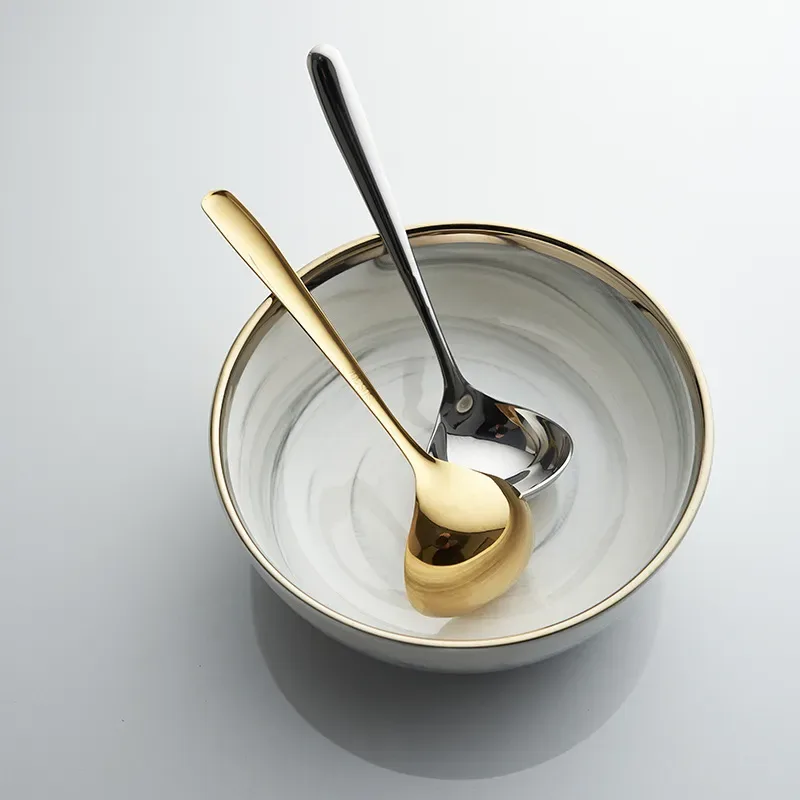
Dinner spoon / tablespoon. The large all-purpose eating spoon. It resembles a teaspoon in shape but is much larger. Note the terminology trap: in cooking measurements a "tablespoon" is a fixed volume, but as a flatware piece it is simply the large spoon in the place setting. When a quote says "tablespoon," confirm whether it means the eating utensil or a measuring spoon — they are different products.
Soup spoon. A wider, deeper oval bowl than the tablespoon, designed to hold more liquid. The bowl geometry, not the handle length, is what makes it a soup spoon.
Bouillon spoon. A smaller soup spoon with a round bowl, used for clear soups and broths.
Dessert spoon. A wide, deep, oval-bowled spoon for puddings, custards and ice cream. It is often similar in size and shape to a soup spoon, which is why the two are frequently confused in catalogs.
Teaspoon. The small, ubiquitous piece used for stirring tea and coffee and for eating small desserts, cereal and soup. It is the most-used spoon in most households and appears in nearly every set.
Demitasse spoon. The smallest spoon in the range, for espresso and miniature desserts, usually with a slightly smaller bowl and a proportionally longer handle.
Iced tea spoon. A long, thin handle with a small oval bowl, for tall drinks, parfaits and sundaes.
| Spoon type | Other names | Size class | Typical role |
|---|---|---|---|
| Tablespoon | Dinner spoon | Largest place-setting spoon | Main dishes, cereal, soup |
| Soup spoon | Round-bowl spoon | Wider, deeper bowl than tablespoon | Soups, chowders, broths |
| Dessert spoon | — | Close to a soup spoon | Puddings, custards, ice cream |
| Place spoon | — | Bowl slightly larger than a teaspoon | Everyday dining, soup, dessert |
| Bouillon spoon | — | Smaller soup spoon, round bowl | Clear soups and broths |
| Teaspoon | Coffee spoon | Reference small spoon | Stirring, small portions |
| Demitasse spoon | Espresso spoon | Smallest bowl, long handle | Espresso, miniature desserts |
| Iced tea spoon | Iced beverage spoon | Long thin handle, small bowl | Tall drinks, parfaits |
The place spoon deserves a note: Etiquette Scholar defines it as the medium-size all-purpose spoon with a bowl slightly larger than a teaspoon, and it is the piece most often substituted for a soup spoon in boxed sets.
Place Settings: How 3-, 4- and 5-Piece Sets Are Composed
Place settings are built in layers, and understanding the layers is what lets you read a set description without opening the box. The layer definitions below follow Etiquette Scholar's account of place settings.
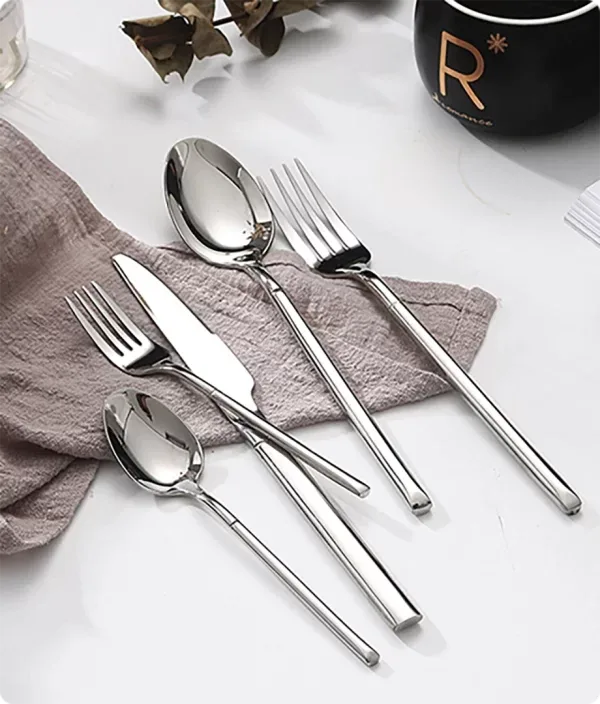
Three-piece setting. The documented minimum: dinner knife, dinner fork and teaspoon. This is the smallest coherent setting and the basis for many budget and institutional assortments.
Four-piece setting. Adds a salad fork. Because the salad fork doubles as a dessert utensil in informal dining, this is a common configuration for everyday household sets.
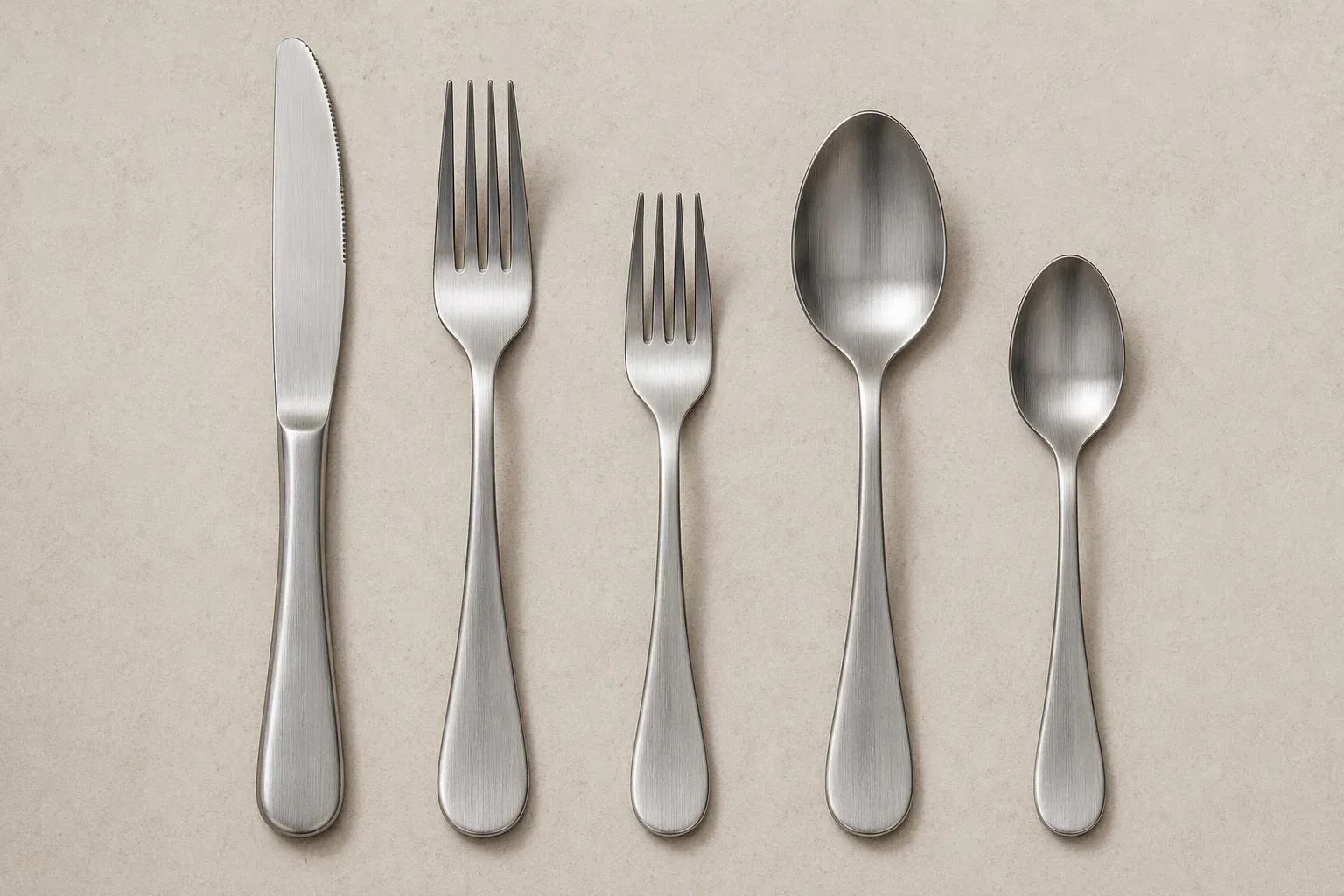
Five-piece setting. Adds a soup spoon or place spoon. The most widely quoted five-piece composition is a dinner knife, dinner fork, salad fork, tablespoon or place spoon, and teaspoon.
| Set size | Typical contents | Typical use |
|---|---|---|
| 3-piece | Dinner knife, dinner fork, teaspoon | Minimum setting, institutional |
| 4-piece | Dinner knife, dinner fork, salad fork, teaspoon | Everyday household |
| 5-piece | Dinner knife, dinner fork, salad fork, tablespoon or place spoon, and teaspoon | Standard retail place setting |
| 20-piece | 4 five-piece place settings | Couples, small households |
| 45-piece | 8 place settings + 5 serving utensils | Families, small cafés |
| 65-piece | 12 place settings + 5 serving utensils | Large households, small restaurants |
These are common configurations, not universal standards. Composition varies by market and channel. Retail gift sets may substitute a dessert spoon for the soup spoon, or add a butter knife for a breakfast-oriented assortment. Hospitality buyers often specify their own combination rather than accepting a retail set definition.
Larger sets are place settings multiplied, plus serving pieces. A 45-piece service for eight typically adds five serving utensils — two serving spoons (one solid, one pierced), a serving fork, a meat fork and a butter spreader, per Etiquette Scholar's list. When matching serving utensils are bought as a hostess set, a four-piece set typically contains a tablespoon, sugar spoon, gravy ladle and cold-meat fork; a six-piece set usually contains a pie server, pierced tablespoon, solid tablespoon, cold-meat fork, butter spreader and sugar spoon. If you are building a private-label program, decide early whether serving pieces are part of the set or a separate SKU — it changes both the carton configuration and the price story.
Reading a Supplier Quote: Telling a Dinner Knife from a Steak Knife from a Butter Knife
This is the question that generates the most email between buyers and factories, and it has a reliable answer. Read the knife by its geometry, not its label.
- Edge type. Serrated or micro-serrated with visible teeth points toward a dinner or steak knife. A completely dull, smooth edge points toward a butter knife or spreader. A scalloped or serrated edge on a longer blade is usually a steak knife.
- Tip shape. A rounded tip suggests a dinner knife, butter knife or spreader. A pointed tip suggests a steak knife or a more aggressive table knife design.
- Blade length and overall length. Steak knives typically run longer than butter knives. Measure both blade and overall length; a long handle can disguise a short blade.
- Whether the piece is described as a spreader. "Spreader" almost always means the flat, dull, short spreading piece. "Butter knife" is looser and may mean either a small table knife or a spreader.
- Whether "table knife" is being used loosely. It usually means the dinner knife, but some suppliers use it as a category heading covering dinner, luncheon and butter knives alike.
Two habits prevent almost all of these errors. First, ask for a photograph, a line drawing and measured dimensions for every quoted piece — not just the hero image of the pattern. Second, check the edge and tip against the drawing rather than the name in the description column. A supplier who can supply all three is a supplier who understands its own product; one who cannot is a risk on a repeat order.
If you are comparing two quotes for the same item, compare the drawings side by side before comparing the price. A cheaper steak knife may turn out to be a dinner knife with a different label.
Stainless Steel Grades: What 18/10, 18/8, 18/0 and 13/0 Actually Mean
The grade numbers on a flatware quote describe the alloy, and misunderstanding them is the most common technical error in flatware sourcing. The compositions below follow the British Stainless Steel Association's explanation of cutlery grades.
18/8 is the most commonly used stainless steel, containing approximately 18% chromium and 8% nickel. It is the austenitic grade known as AISI 304, or 1.4301 in the European standard, and it is only weakly attracted by a magnet.
18/10 is a designation used on some cutlery as an alternative to 18/8. It is claimed to indicate better quality, but the association describes it as essentially the same 304 grade and states that the "10" does not indicate an actual higher nickel content and is purely a marketing designation.
18/0 is a ferritic stainless steel, attracted by a magnet, known as AISI 430 or 1.4016. It is used where corrosion resistance is not too demanding, as an alternative to 304. Its chromium content is optimistically stated as 18% but is nearer 17%, and it contains no nickel.
13/0 belongs to the martensitic family: chromium with additional carbon, which is what lets it respond to hardening heat treatment and therefore take a cutting edge. WebstaurantStore's guide describes 13/0 as 13% chromium and no nickel, and notes that most dinner and dessert knives are made from it. Note what the designation is and is not: it is a trade way of writing a chromium-and-no-nickel martensitic steel, not an AISI grade, so two factories writing "13/0" are not necessarily offering the same alloy. Ask for the material certificate that names the grade on the order.
The correction buyers need to internalize: a higher grade number does not automatically mean better corrosion resistance in the finished piece. Grade, construction and use conditions all matter. A two-piece knife with a martensitic blade and an 18/10 handle is a different product from a one-piece martensitic knife, even if both are described as "stainless steel." And the exact alloy should always be confirmed against the supplier's material specification rather than inferred from the marketing number.
Grade is also separate from gauge and weight. The grade numbers do not refer to the thickness of the flatware, which is what determines how heavy and rigid a piece feels — WebstaurantStore makes the same point in its own buying guide. Supplier weight grades typically run from medium weight (thinner, more prone to bending) through heavy weight to extra-heavy weight, with forged flatware shaped from thicker stock rather than stamped sheet. An extra-heavy 18/0 fork can feel more substantial than a medium-weight 18/10 fork, even though the 18/10 piece generally offers better corrosion resistance. Evaluate grade and weight separately, and compare actual piece weights in grams and material thickness in millimeters before placing a bulk order.
Specifying Flatware in RFQs and SKU Lists
An RFQ is only as good as the attributes it pins down. The template below covers the fields that cause most sampling disputes; adapt the order to your own system, but do not drop a field without deciding it does not matter.
Required attributes per line:
- Piece name plus size class (e.g., "dinner fork, place size")
- Steel grade and alloy reference (e.g., "18/10, AISI 304")
- Construction (stamped or forged; one-piece or two-piece for knives)
- Gauge or piece weight in grams
- Length in millimeters and inches
- Edge type for knives (micro-serrated, serrated, blunt, smooth)
- Finish (mirror polish, matte, brushed, PVD color)
- Handle material and attachment method
- Packaging configuration (pieces per set, sets per carton, inner packaging)
- Branding method (laser engraving, embossed logo, printed packaging)
- Compliance and testing requirements: FDA food-contact conformity for the US; for the EU, Regulation (EC) No 1935/2004 with GMP under Commission Regulation (EC) No 2023/2006; and any national requirement of the destination market, such as German LFGB
Sample SKU line:
MF-DF-205-1810-MP | Dinner fork, place size | 18/10 (AISI 304) | stamped, 4.5 mm | 62 g | 205 mm / 8.07 in | mirror polish | 5-pc set, 4 sets/carton | laser logo on handle | FDA + LFGB
Sample RFQ paragraph:
We are sourcing a 5-piece place setting for the US retail market. Please quote per piece and per set: dinner knife (two-piece, martensitic blade with 18/10 handle, micro-serrated edge, rounded tip, 230 mm), dinner fork (18/10, 205 mm, 62 g), salad fork (18/10, 180 mm, 45 g), place spoon (18/10, 190 mm, 55 g) and teaspoon (18/10, 145 mm, 30 g). Finish: mirror polish. Packaging: five pieces per gift box, four boxes per carton, logo engraved on handle. Please confirm material specification, piece weights, thickness, and FDA and LFGB test documentation, and provide a line drawing and photograph of each piece.
The governing principle is simple: names are labels and measurements are the contract. Every attribute you leave out is an attribute the factory will choose for you. Specify it, or accept whatever the name allows.
Food-Contact Paperwork: What to Ask For
Quotes often carry the line "FDA approved" or "LFGB certified". Neither is a status a manufacturer holds across a catalogue. What exists is a route for a specific material, in a specific use, for specific parts.
In the United States, food-contact articles fall under FDA regulation through Title 21 of the Code of Federal Regulations. Part 174 sets out the general provisions for substances used in articles that contact food: use under conditions of good manufacturing practice, the quantity reasonably required to do the job, and purity suitable for the intended use. A substance gets there by being generally recognized as safe, by a prior sanction, by a regulation in Parts 175–178, by an effective premarket notification for a food contact substance, or through the threshold-of-regulation exemption at § 170.39. What that structure supplies is a route for a material and a use, not a certificate that covers a whole catalogue.
In the European Union, the European Commission's food contact materials page states the framework: all food contact materials must comply with Regulation (EC) No 1935/2004, and all must be manufactured in accordance with Good Manufacturing Practice under Commission Regulation (EC) No 2023/2006, alongside national legislation on materials not covered by specific Union rules — which is where a German LFGB request comes from. When a supplier writes "LFGB" on a quote, the useful question is which laboratory, which test and which parts of the set were tested.
A short checklist for the paperwork:
- Ask for the test report itself rather than a picture of a certificate: laboratory name, report number, date, the method applied, and the parts and finishes covered.
- Match the report to the alloy on the material certificate. A report for 18/10 does not cover a 13/0 blade.
- Check the date, and check that the parts tested are the parts in this order.
- Ask which statements the supplier will put in writing, and keep the approved sample and specification sheet with them.
Each report covers the material, the finish and the test condition named in it. Read it against the regulation that applies in your market, and keep the set of documents — report, material certificate, drawing — together, because a supplier who can send all three for the same item is telling you something about how the next order will be run.
Common Beginner Mistakes to Avoid
- Ordering by name only. "Dinner forks" without dimensions invites whatever the factory considers standard. Always add length, weight and grade.
- Assuming all 5-piece sets contain the same pieces. Composition varies by market, channel and pattern. Read the contents list, not the set size.
- Confusing steel grade with weight or gauge. Grade describes the alloy; gauge and thickness drive how the piece feels and how well it resists bending. Specify both.
- Treating 18/10 as automatically superior. The British Stainless Steel Association describes it as essentially the same 304 grade as 18/8, with the "10" functioning as a marketing designation.
- Ignoring edge type on knives. A dinner knife and a steak knife can look similar in a catalog photo. Check the edge and tip on the drawing.
- Leaving packaging and branding out of the RFQ. Carton configuration, gift box and logo method change cost and lead time, and are frequently the source of a late-stage dispute.
- Taking "FDA approved" as a document. No supplier is approved as a company for all its products. Ask for the report: laboratory, number, date, parts covered.
- Assuming a size chart settles the dimensions. It does not. The drawing and the measured sample do.
- Not confirming repeatability. Ask explicitly whether the same pattern, finish and specifications can be reproduced on the next order, and keep the approved sample and spec sheet on file.
How We Quote: MOQ, Sampling and OEM/ODM
We quote against a specification, not against a name. The minimum order is set per style and comes with the quotation, because the pattern, the finish, the packaging and the quantity you take all move it. Sample orders are available — standard or customized — for evaluation before you commit to a large order. OEM/ODM customization covers logos, packaging, bespoke designs, shapes, sizes, colors and handle designs, and a custom design is quoted the same way, per design and per specification.
Pricing moves with quantity, customization and long-term cooperation, and the specification you send is what we can quote against. If you have a pattern reference, a target price and a market, send them with the attribute list from the RFQ section above; that is the fastest route to a comparable sample.
Our flatware ranges are listed on the wholesale flatware page, and inquiries reach us through the contact page.
FAQ
How do I tell a dinner knife from a steak knife from a butter knife on a quote? Look at the edge and tip. A dinner knife has a rounded tip and a blunt or micro-serrated edge; a steak knife has a sharper serrated edge and often a longer blade; a butter knife or spreader has a dull edge and a rounded point and is usually the smallest knife. Request a drawing and measured dimensions to confirm. See Reading a Supplier Quote.
What belongs in a 5-piece place setting? The most common composition is a dinner knife, dinner fork, salad fork, tablespoon or place spoon, and teaspoon. Composition varies by market and channel — retail gift sets and hospitality assortments often substitute pieces. See Place Settings.
Where do the size ranges in this guide come from? The size classes come from etiquette reference material and the individual descriptions come from suppliers' own product guides; the millimetres come from nobody but your supplier. No chart settles a dimension for you, so ask for the drawing and write the measured length into the order. See The Vocabulary Problem.
How do I write an SKU line and RFQ? Include piece name plus size class, steel grade and alloy reference, construction, gauge or piece weight, length in millimeters and inches, edge type for knives, finish, handle material, packaging, branding and compliance requirements. The Specifying Flatware in RFQs section includes a copyable SKU line and RFQ paragraph.
Which attributes should I pin down to avoid sampling errors? Length, piece weight, material thickness, steel grade, edge geometry, finish and handle construction. These are the attributes that vary between factories using the same name.
What do the steel grades mean, and does a higher grade guarantee better corrosion resistance? The numbers denote chromium and nickel content. 18/8 is the common austenitic 304 grade; 18/10 is essentially the same grade, with the "10" functioning as a marketing designation; 18/0 is ferritic 430 with no nickel; 13/0 is a martensitic, chromium-and-carbon steel with no nickel, used for blades and lower-cost single-piece cutlery. A higher number does not automatically mean better corrosion resistance — grade, construction and use conditions all matter. See Stainless Steel Grades.
How do I check the food-contact documents a supplier sends? Ask for the test report rather than a certificate image, and read the laboratory, the report number, the date, the method and the parts covered. Confirm the material certificate matches the alloy quoted, and ask which statements the supplier will put in writing. See Food-Contact Paperwork.
What are your MOQ, sampling and OEM/ODM terms? The minimum order is set per style and quoted with your specification, because pattern, finish, packaging and quantity all move it. Sample orders are available, including standard or customized samples. OEM/ODM covers logos, packaging, bespoke designs, shapes, sizes, colors and handle designs. See How We Quote.
If you have a quote in front of you now, take the attribute list in Specifying Flatware in RFQs and work down it line by line; whatever you cannot answer from the supplier's documents is what to ask before the sample ships.