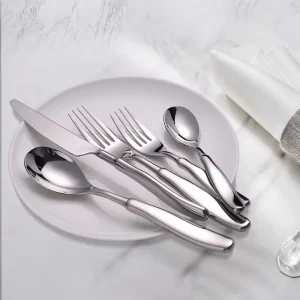
Choose the service count and exact utensils before deciding what the retail box should promise.
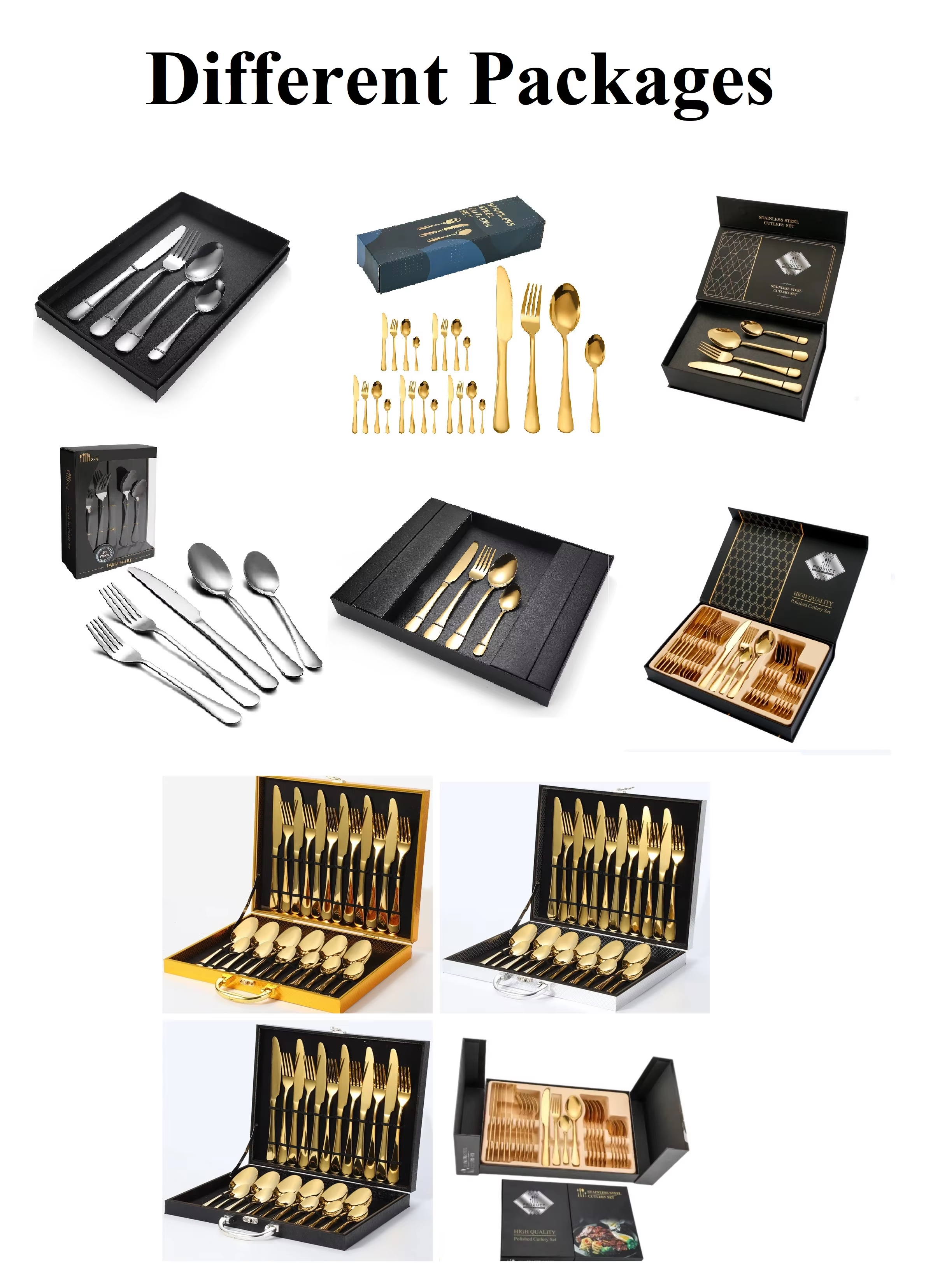
The buying decision Piece count, number of diners and component quality are separate decisions. Define all three before comparing retail sets.
A larger piece count does not automatically mean a more useful flatware set. A 24-piece box can serve six people with four utensils each, while a 20-piece box can serve four with five utensils each. Both can be sensible products, but they answer different customer needs.
For a distributor, choosing a retail flatware set configuration affects positioning, packaging, replenishment and production quantities. Define the table service first, then calculate the piece count. This prevents the box label from becoming the starting point for a product that does not fit its market.
Write the bill of contents in plain language
The following configurations are examples rather than universal definitions. Retailers use different combinations, and a serving utensil may be included in the headline count.
| Illustrative retail configurations — actual contents vary by product | |||
| 20-piece | 4 | Dinner knife, dinner fork, salad fork, spoon, teaspoon | 20 |
| 24-piece | 6 | Dinner knife, dinner fork, spoon, teaspoon | 24 |
| 30-piece | 6 | Dinner knife, dinner fork, salad fork, spoon, teaspoon | 30 |
Use full utensil names in the specification and on the retail listing. “Two spoons” does not tell a buyer whether the smaller piece is intended for coffee, dessert or another use. Names also vary between countries, so include dimensions and a clear contents photograph.
Match the set to the buyer’s actual table
Talk to the retailers or dealers who will stock the product. Ask which household sizes they serve, whether customers buy dinnerware in sets of four or six, and which utensils are frequently requested separately. These are better inputs than assuming one country’s familiar set format fits every export destination.
Position a smaller set around a defined use rather than treating it as an incomplete version of a larger box. A compact four-person set may suit limited storage or a particular price point. A six-person set may work for customers buying coordinated household tableware. Neither claim requires inventing market-share statistics.
Convert retail sets into component demand
Suppose a distributor plans 600 of the example 24-piece sets and 400 of the example 30-piece sets. Both contain six each of the dinner knife, dinner fork, spoon and teaspoon. Production therefore needs 6,000 of each common component. Only the 30-piece format includes salad forks, so it needs 2,400 of those.
The total is 600 × 24 + 400 × 30 = 26,400 individual utensils. This arithmetic matters because the uncommon component can have a different minimum or availability. Confirm that all required pieces belong to the same approved pattern and can be supplied on the same schedule.
A clear packing layout helps buyers verify the contents of a retail set. AI-generated conceptual illustration; not an actual Mcallen product, factory or test photograph.
Design the packaging around the real contents
Do a physical pack trial with the intended knives and spoons. Longer or deeper pieces can force a box change even when the total count stays the same. Check that pieces remain separated, are easy to count and can be removed without damaging the insert.
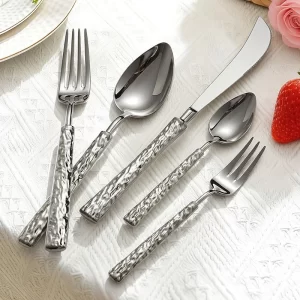
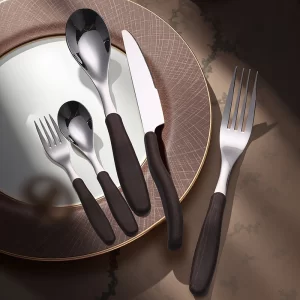
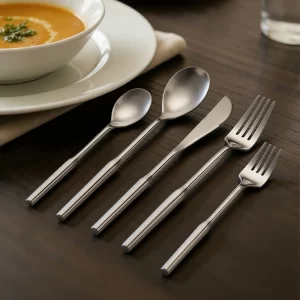
Photograph the complete contents for retail approval. If serving pieces are included, show them separately and explain the place-setting count. “Service for six plus two serving utensils” is clearer than leaving customers to infer the number of diners from a total of 26 pieces.
Keep front-of-box claims, the website contents list and the assembly checklist synchronized. Changing one teaspoon to a dessert spoon is a product change even if the headline piece count remains identical.
Before approving artwork, ask a colleague to reconstruct the contents using only the draft product listing. If they cannot identify the number of diners and the quantity of each utensil, revise the listing before printing. This is a simple clarity check, not consumer research. It is especially useful when the same pattern appears in several box sizes with similar photographs.
Decide how replacement pieces will be sold
A consumer may lose a fork long before the rest of the set needs replacing. Ask whether the pattern can support open-stock pieces and whether your channel can handle those orders economically. Record individual-piece codes separately from retail-set codes.
Do not promise indefinite availability without a supply arrangement. Instead, define the current replacement policy and review it when molds, finishes or the range change. Mcallen’s gift-set category can support the initial assortment discussion; the final contents must be confirmed for the selected model and order.
Wording to adapt for your next RFQ
Please quote the selected pattern for each proposed retail configuration. List the exact quantity of each knife, fork and spoon, the intended service count, component materials and dimensions. Identify any serving pieces included in the headline count. Provide the proposed insert, retail-box size, packed weight, carton quantity and minimum order for each configuration. Confirm whether matching individual utensils can be ordered for replenishment.
Adapt this request to the selected product, destination and order. Resolve open items before confirming the purchase.
Questions buyers ask
Is a five-piece setting more premium than a four-piece setting?
The extra utensil changes the contents, not necessarily the workmanship. Evaluate material, geometry, finish and packaging independently from the count.
Can I use one product listing for different set sizes?
Use clearly identified variations if your sales channel supports them. Each option needs an accurate contents list, image and inventory identity so customers receive the configuration they selected.
Develop a retail set with clear contents
Share the exact utensil quantities, intended household size and packaging format to request a retail set proposal.
Explore cutlery gift sets ↗Discuss your order
Sources & editorial basis
- Mcallen cutlery gift-set collection — Current product range for configuration and packaging discussions.
- Mcallen customization options — Set packaging and component customization context.
Further reading: How many pieces are in a cutlery set?