How to Source Custom Measuring Spoons: What 1M Units Taught
One million branded 30 mL scoops, two sample rounds and three published SGS reports: what made this custom measuring spoon order checkable.
In February 2025, METALFLOW, a German brand, confirmed an order with us for one million stainless steel measuring spoons: a single 30 mL scoop in 18/10 steel, mirror polished, with its logo engraved. The run was produced, inspected and delivered on the agreed schedule, according to our project file and shipping records for the order. Sourcing custom measuring spoons at that volume is decided long before production starts, and that is the part worth describing.
A spoon looks like an easy order until the number is a million. Then a polishing band a buyer might tolerate on a 5,000-piece run becomes a warehouse of rejects, and a missing food-contact document becomes a container that cannot legally be sold in Europe. What made this order predictable was a sequence rather than a promise: a written specification, a reference sample both sides had handled, inspection evidence during the run, and paperwork read before production instead of after it.
Three kinds of evidence appear below, and they are worth keeping apart. The steel, finish and food-contact rules are public: regulations, and the test reports we publish. The dates, inspection stages and delivery statement come from our own project file and from correspondence with the buyer, and no independent inspection body has audited them. Where a claim is one a buyer should check rather than accept, the article says so.
Table of Contents
What does a million units change about a spoon order?
Three things: the cost of one defect, the cost of a problem nobody mentions, and how much of the order exists by the time you notice.
The arithmetic is worth doing once. At one million pieces, a 0.3% defect rate is 3,000 spoons; the same rate on a 5,000-piece order is 15. On the small order that may be tolerable. On the large one it is not, and by the time the goods reach a port the remaining choices are a claim, a delay or an argument. The reason to inspect halfway through a million-piece run is that a deviation found there can still be corrected inside the run.
METALFLOW was not buying a generic utensil either. The spoon carries its logo into European kitchens and into photographs, and it is judged by people who will never read a test report, only the object in the hand and on the screen.
Why "18/10 steel and a mirror polish" is not yet a specification
Both are starting points. Neither tells a mill or a polishing line what to reproduce, and on this order each had to become measurable before the first production piece was made.
18/10 is a trade designation, not a certificate. The cutlery convention reports chromium and nickel content, and 18/10 sits in the same AISI 304 family as 18/8: the British Stainless Steel Association describes "18/10" as a marketing designation rather than evidence of a verified higher nickel content. That is no argument against choosing it; it is an argument against treating the label as the specification. What a buyer should hold is the alloy, the construction and the piece weight or thickness, confirmed on the material record for the order. Our grade options run from 18/10 and 304 to 316, 430 and 420/410 for specific pieces, and the grade belongs to the product and the process, not to the catalogue.
"Mirror" describes a process, and the result depends on the starting mill finish, the grit sequence and the buffing compound. A scoop is also the wrong shape for a test coupon. The inside of the bowl curves, and a polishing line that gives a flawless reflection on a flat plate can leave a slightly duller band where the bowl turns up toward the handle. That is settled by agreeing a reference sample and holding both sides to it, and our guide to mirror, brushed and coated finishes sets out how they differ in wear and in care.
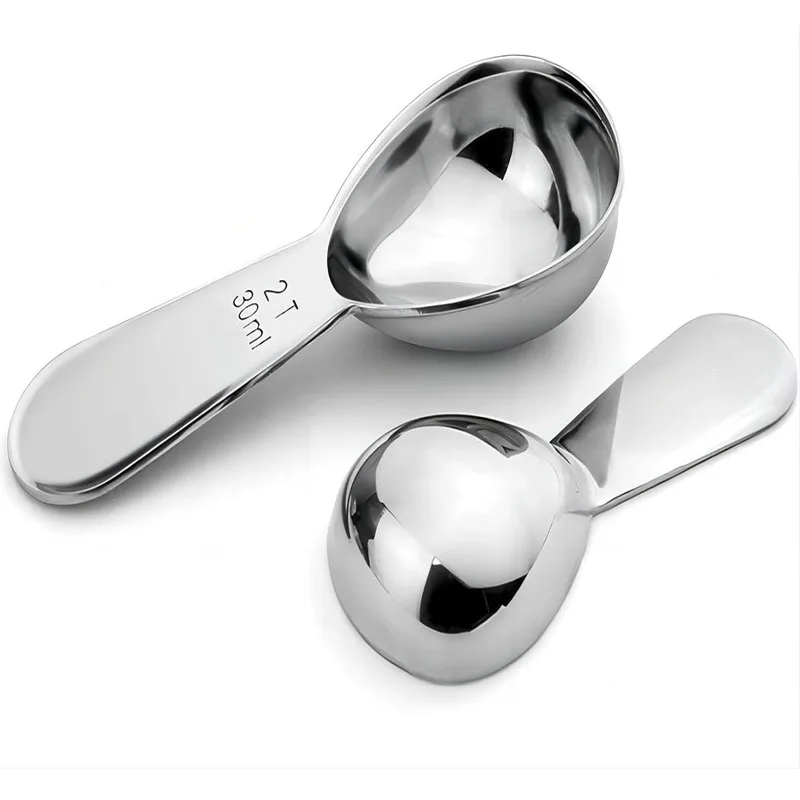
The engraving followed the same rule. A mark cut too deep drags polishing compound and reads muddy; a mark cut too shallow wears away in the wash. It was validated on the sample rather than specified on paper, and video of the laser engraving was sent during the run so line quality could be checked instead of described.
How long do two sample rounds actually take?
Closer to five months than to a fortnight. The first sample was requested on 26 August 2024 and the branded sample was approved on 22 January 2025, with the bare sample shipped the day after the first request.
The branded version was a separate step. A sample carrying the logo was requested on 6 January 2025, photographs of it went back on 9 January, and approval came on 22 January. The three days between request and photograph is a photo turnaround, not a completed sample cycle, which is why the five-month span is the figure to plan with.
Between those milestones the samples did the work that matters: 30 mL capacity confirmed, the finish settled on a curved bowl rather than a flat coupon, and the logo checked at production scale. The buyer's written feedback on the branded sample included the line we want from every customer: "We actually like the scoop." The writer appears in the file by role only, as METALFLOW's contact.
The order confirmation landed in February 2025, with the intent recorded on 6 February and a proforma invoice on 11 February, in the middle of the Chinese New Year period, when much of Chinese manufacturing goes quiet and a European buyer's emails stop being answered.
A change made on a sample costs days. The same change made after a million spoons have been stamped, polished and engraved costs a rework programme, or a shipment.
What should arrive while the goods are being made?
Evidence, not silence. A buyer who hears nothing for weeks cannot tell a factory running smoothly from one fixing a problem quietly, and a million-piece run leaves the factory weeks in which to do either.
During this order we sent bulk production photographs, video of the laser engraving and information on the packaging materials, so each stage could be reviewed at a distance before the next began. Shipping and tracking updates went out through the delivery phase rather than being asked for. The finished goods passed final inspection against the approved sample and shipped without a rework run, according to our inspection records for the order.
Quality control here runs through defined stages, stamping, polishing, surface processing, cleaning and final packing, with an intermediate inspection during production and a final inspection before shipment. What a buyer should ask for is that structure applied to their own order, and one example of the record it produces.
Two cautions belong with that. Published times on our pages differ by page: a product page may quote a sample in days, the custom page describes design-led sampling and production windows, a category page quotes weeks. Treat all of them as indicative, and put the delivery date, the inspection points and the remedy for a missed date into the order. Third-party inspection and factory audits are both available, and an audit normally belongs after shortlisting and before a deposit, not after the first container.
Which food-contact papers should you read before the order?
The ones for the finished article, in the market you sell in: not a mill certificate for the steel coil, and not a logo on a homepage.
In the United States, the FDA regulates food-contact substances but runs no approval programme for finished cookware, so "FDA approved" overstates what the agency does. What a buyer can ask for is a letter of guaranty naming the product, the finish or coating, whether it is single or repeated use, the foods it will contact and the regulation it relies on, together with the test report behind it. In the European Union, Regulation (EC) No 1935/2004 requires that materials do not transfer constituents into food in quantities that endanger health or change the food's composition, taste or odour, with the German LFGB Sections 30 and 31 alongside it for that market and separate measures applying to coatings. Cadmium is restricted separately under REACH Annex XVII.
We publish the cover pages of three SGS test reports on our flatware:
- GZHL2406026935CW, 2 July 2024: cadmium and cadmium compounds under REACH Annex XVII, entry 23, reported as a pass.
- CANHL24013953701, 4 July 2024: total chromium content under the US FDA GRAS specification, reported as a pass.
- CANHL24013953501, 4 July 2024: sensory test and extractable heavy metals under LFGB Sections 30 and 31 and Regulation (EC) 1935/2004, reported as a pass.
Three things matter more than the word "pass". These are cover pages of multi-page reports, not the reports themselves. They identify the samples tested, not every configuration we make, so a report has to be matched to the article, grade and finish you are buying. And a test report is not a management-system certificate.
That distinction is one a case study should not settle for you. A management-system certificate is a document with a number, a stated scope, an address and an expiry date, and it is the document, not the mention of ISO 9001 among our pages, that a buyer can check. If your sourcing process needs one, ask us for the certificate itself and its scope, then verify it with the issuing body, because a certificate held by a trading office does not necessarily cover the factory that makes your goods.
How do you turn "on schedule" into something you can check?
Two statements in this account need that treatment: "delivered on schedule" and "no rework run". Neither is a document that travels with the goods, and both become stronger for the buyer once they are written into the order rather than read in a case study.
Ask for the inspection record produced on your own order, and put the delivery date, the inspection points and the remedy for a missed date into the contract. A case study can show that a supplier has done something once; only the order terms make it repeatable.
How should another brand source custom measuring spoons?
Copy the sequence, not the spoon.
- Specify the alloy and the finish, and back the finish with a reference sample. "18/10" and "mirror polish" are the beginning of a specification; the approved sample is what production gets measured against.
- Plan sample rounds in months, not days. Here the span ran from a request in late August to a branded approval in late January, and that is where capacity, finish and engraving legibility get fixed.
- Agree what production evidence you will receive, and when. Photographs and engraving video are only useful if they arrive while the stage can still be changed.
- Ask for the food-contact documents on the finished article, and read the report rather than the certificate. A mill certificate for the coil answers a different question from a migration test on the spoon.
- Approve packaging before mass production. It is usually the last item specified and the first to cause a delay.
- Decide about third-party inspection or a factory audit before the deposit, when the decision is still cheap.
Planning a run like this one?
Start with the sample, not the purchase order. Send the steel grade, finish, logo artwork, volume and target market, and we can quote against a defined brief. Samples are available for evaluation, and our stated starting minimum for custom orders is 500 sets per style; the applicable figure depends on the design and the process, so confirm it against your brief rather than assuming it.
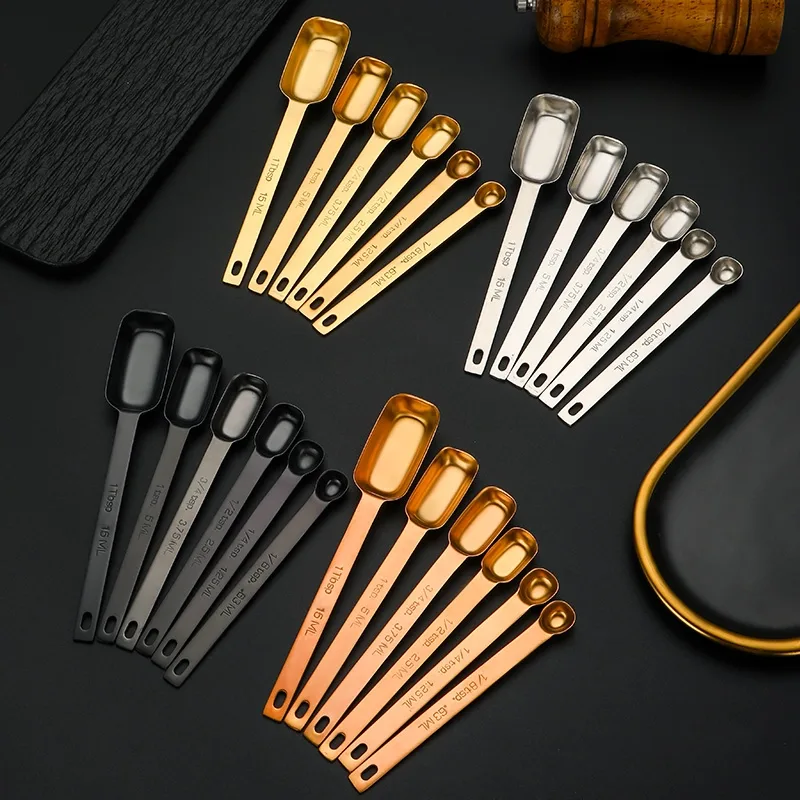
The 30 mL scoop in this order is one shape among the measuring spoons we make. The short-handle 15 mL and 30 mL spoons sit in the wider baking tools and utensils range, and the custom cutlery and kitchen utensils page sets out the OEM options for materials, finishes, marking and packaging.